Post-conference thoughts, reflections, and directions for future research
A version of this article also features on my research site.
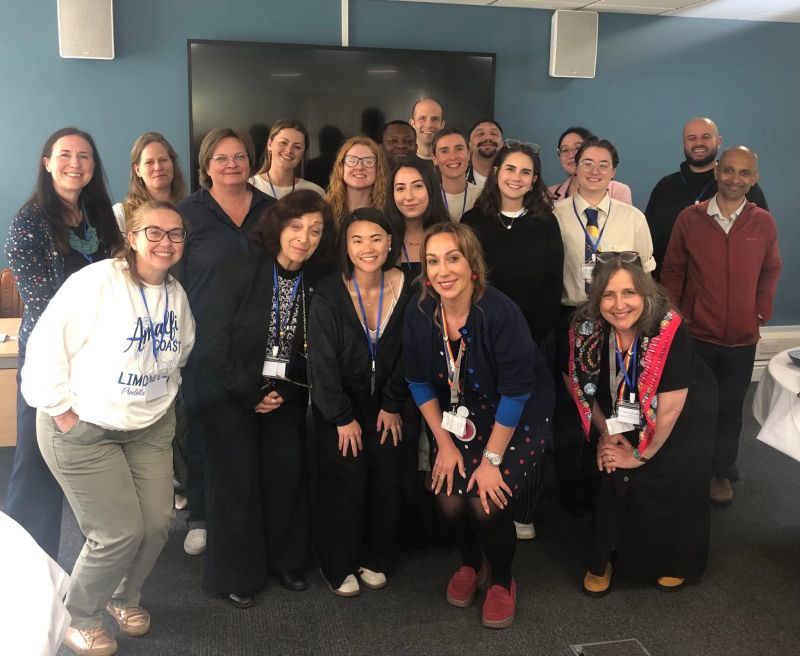
Organised by Drs Lucia Morawska and Samantha Bracey and hosted by Richmond American University London’s Gender in Sport Research Centre, this has got to be one of the friendliest, if not the friendliest, conferences I’ve ever been to (and I’ve been to some friendly ones!) From the informal pub social over pizza the night before to Lucia’s welcoming address in which she introduced the conference as a space where everyone feels valued, heard, and inspired, the atmosphere was conducive to open discussion without fear of judgement. This would genuinely be a great first conference for a postgraduate student to present their work. We had a few too: I particularly enjoyed Alice Blackburn’s poster on women F1 drivers and Rebecca Jackson’s talk on thriving in girls’ football.
Things kicked off with a keynote from Prof Hanya Pielichaty. What I enjoyed about Hanya’s talk was how she expertly interweaved her personal experiences with wider issues in gender, sport, and academia. Indeed, her book Football, Family, Gender and Identity features her personal experiences as a footballer against a backdrop of rigorous research and empirical data. There are definitely parallels with my book on women’s social anxiety (which is probably why my immediate reaction to Hanya’s description of her book was ‘this sounds great!’ – it went straight on my ever-growing TBR list) but also a book project I’m currently working on about lifting weights and the lessons it can teach us about ourselves, our lives, others, and the world. She also spoke about how sports research is a bit different. By this, she meant that we get into it because there’s a personal connection that, for a lot of other fields (she used the example of accounting, which may or may not offend accountants…), just doesn’t exist in the same way.
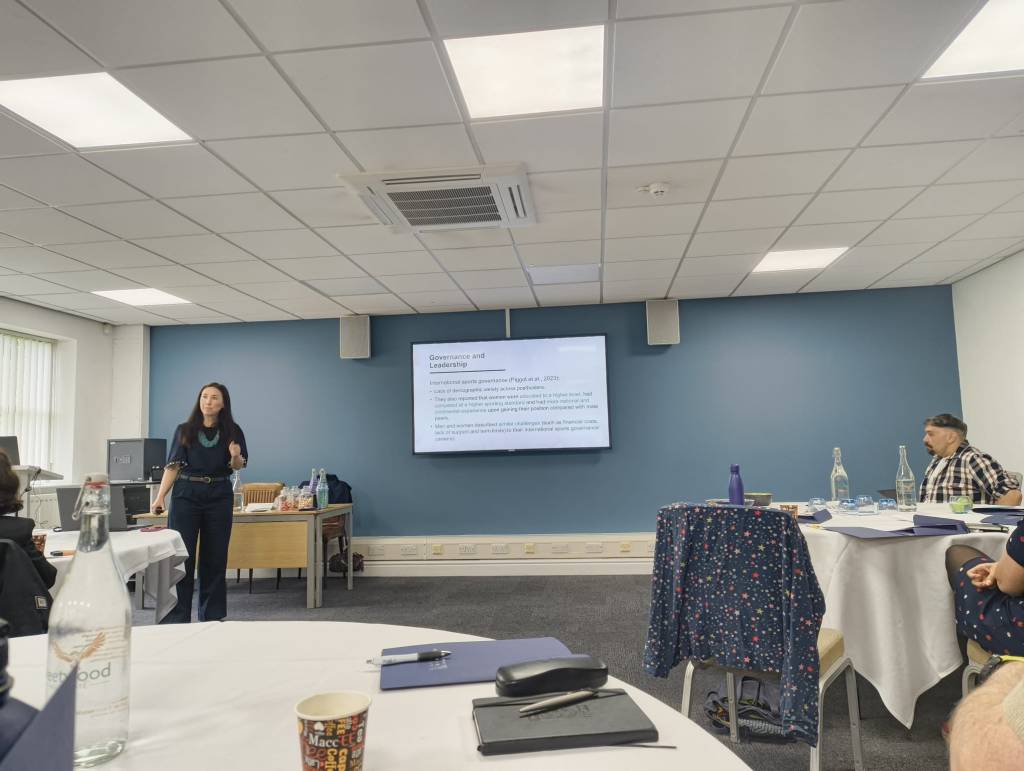
Hanya covered contentious topics such as quotas and threw the current cultural milieux vis-à-vis gender and sport into the mix: we have the first woman IOC president, but many women still do not feel safe while doing sport – for example, being able to run outside without being harassed.
Something else from Hanya’s talk which stuck with me was her mention of women’s being peripheral, but being seen, in sports. She gave a few examples:
- Women’s giving flowers and medals on a tray at the men’s Tour de France
- Women in bikinis with signs walking around the boxing ring
- ‘Grid girls’ in F1
I think it’s an oversimplification to say that this is bad and sexist. And I think Hanya would agree, since she put it to us as to whether these women like their jobs (they might) or whether they feel empowered from them (they also might). With that said, I remember watching these sports as a kid and then later as a teenager (well, maybe not the Tour de France, that might’ve been a bit too highbrow for our household) and feeling that these representations of women sent me very clear messages that I don’t think we can just gloss over because the women in these roles might like it: 1) this is women’s purpose here, to be merely decorative and 2) these sports are not for you.
One of the threads of my Springer Nature article is the distinction between the body’s capabilities and its appearance – what you look like vs. what you can do. Through the lens of lifting weights, this manifests as strength sports, like powerlifting, vs. appearance-focussed pursuits (or sports – for the question of whether bodybuilding is a sport, see Kind and Helms, (2023)), like bodybuilding. So, you might be tempted to think that I think that bodybuilding is evil (to be clear, I don’t think this, but as to exactly why is probably something for another blog post!).
In essence, I don’t think it’s sinful to care about how you look and have aesthetic goals – I don’t think we can completely remove ourselves from how society views bodies and the meanings they ascribe to them. And I think Hanya alluded to this a little in speaking about women footballers on Instagram in bikinis, or landing a big Adidas contract because they showed their body in a certain way.
But returning to women’s representation in sports, when I was a kid, I genuinely believed it was forbidden for women to compete in F1. (This is not true, as Alice Blackburn elucidated in her wonderful poster presentation). I also remember wondering why there were no women snooker players (however, I do recall rejoicing a little bit the first time I saw Michaela Tabb refereeing snooker), and I even remember asking whether there was such a thing as a women’s UFC. Sadly, the reply I got went along the lines of, ‘Hahaha, no, that’d be stupid!’ Obviously this is not true, women’s UFC is a thing. And even though it didn’t exist at the time, this perhaps wasn’t the most inspiring thing to say to a 10 year old girl who was interested in the sport. Who knows, maybe I could’ve been the next Ronda Rousey! And this links to something Hanya mentioned in citing her influential childhood P.E. teacher as well as a recent news article headline – ‘being a good dad matters’ – highlighting the important role that adults have in shaping children’s relationships with physical activity and sport.
We then divided into two parallel sessions, and I honestly wanted Hermione Granger’s Time Turner so I could go to both, but opted in the end, after much deliberation, for Gendered Pathways, Participation, and Structural Inclusion. Up first we had Dr Seamus Kelly’s fascinating talk on women’s underrepresentation in football coaching in Ireland, particularly in senior leadership roles. The findings indicated that this is a result of structural/organisational constraints, which echoed some of what Hanya talked about in her keynote. Also, I was interested to discover Seamus’s background as a footballer and football coach, which spoke to the notion of sports research being very personal.
Next up we had Dr Lucy Grimshaw’s case study of a grassroots women’s and girls’ football club, and I was interested to learn that there hasn’t been much prior research on 1) grassroots women’s and girls’ football clubs and 2) research in this vein which pays particular attention to the experiences of women’s and girls’. One quote which I’ve found difficult to forget is from one of the coaches whom Lucy and her colleagues interviewed: ‘I don’t believe the girls’ sections get the same access’.
This provides a convenient segue into Rebecca Jackson’s research on gender gaps in physical activity and sports participation, viewed through the lens of girls’ football. One thing (among many) that I took away from Rebecca’s talk was that, by 14, girls are twice as likely to drop out of sports, making adolescence a key period for intervention. (As an aside, this seems to parallel the gender gap in girls’ participation in STEM which, when I last checked, begins to take root sometime during secondary education.) A key theme running through Rebecca’s talk was how gender inequalities exist within, and then become produced by, the way that sports environments are organised – it’s not an easy case of attributing them to this or that factor. With that said, I was absolutely horrified when she showed us this:
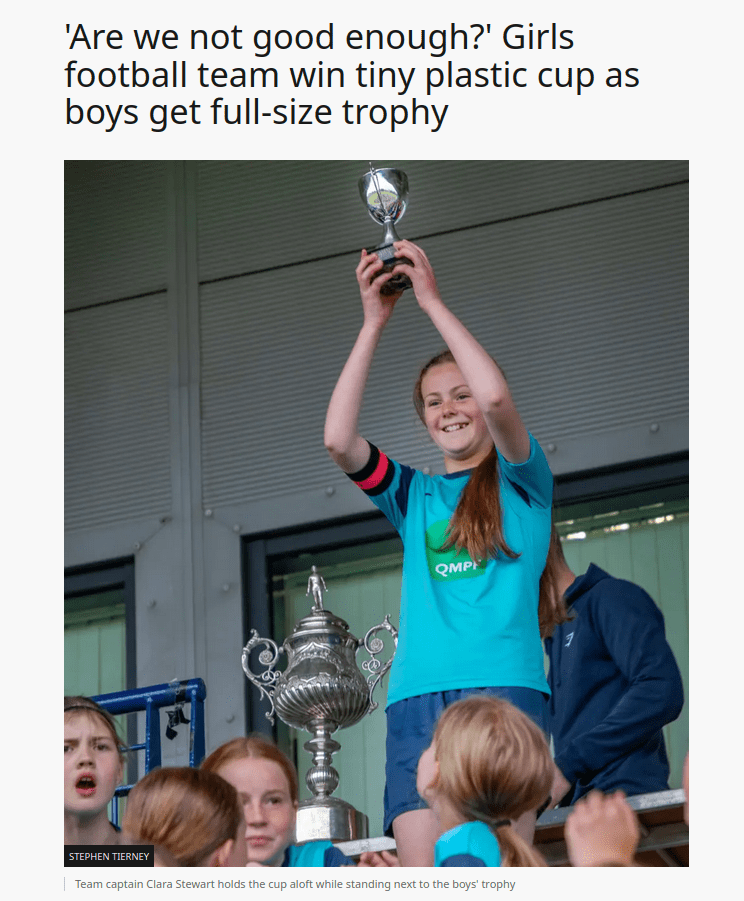
Can we just take a moment to appreciate the (justified) unbridled outrage on the face of the girl in the bottom left? My sentiments – and probably the look on my face – were the exact same when Rebecca showed us this. Stuff like this really brings to light just why work like Rebecca’s is so needed.
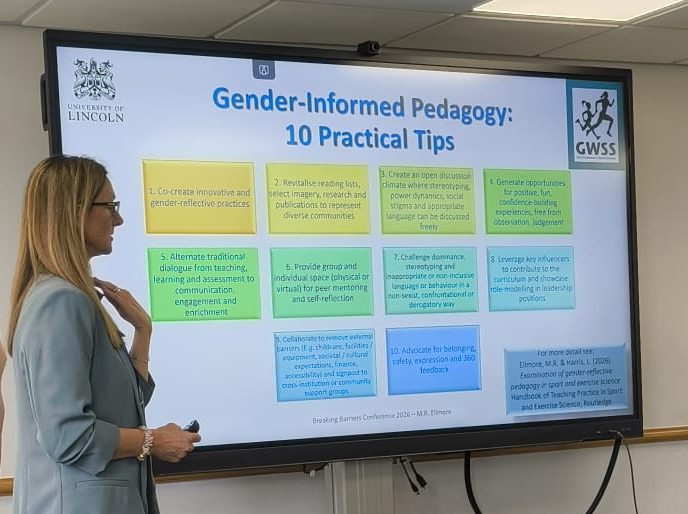
Rounding off the session we had Dr Mistrelle Elmore’s presentation on gender-informed pedagogical practices in sports and exercise science. Coming from a STEM background, a lot of what Mistrelle spoke on resonated with me: women are underrepresented, the field is ‘stubbornly male-dominated’, and women are not equally rewarded for doing the same work. Mistrelle also spent some time talking about belonging, and the extent to which women in the field feel like they do belong – and the ramifications of that, and what might feed into it (e.g. not asking women students to do the demo, lack of visibility in marketing materials). But it’s not all doom and gloom: she gave us 10 practical tips to foster a more inclusive climate:
By the time we finished up, I was tunnel-vision to the dining hall for a three course hot lunch. (I’ve never been so well fed at a conference, seriously). I did an enjoyably gruelling lower body lifting session* before driving up to the beautiful Weetwood Hall Estate on the Wednesday afternoon, so by the time Thursday came around I was absolutely starving. In her book A Physical Education, fellow lifter Casey Johnston calls this The Hunger. I’d also like to apologise to anyone who was around me for not being as social as I’d usually have been until I’d packed away my starter and main course!
Now suitably well-fed, I shared my parallel session with philosophy professor Martine Prange, whose comprehensive arguments for equal pay for women’s football left me agog. In particular – and I spoke about this with Martine afterwards – my knee-jerk-if-I-was-being-devil’s-advocate response to Martine’s initial statement of her argument was The Revenue Argument: that is, that women’s football brings in less money than men’s, therefore salaries should be proportionate. But a few seconds after I had this thought, Martine laid out in their presentation exactly why this argument falls down. In brief, the commercial value of women’s football is what it is because of its history (it was literally banned for half a century, starting in 1921). So The Revenue Argument sets up a loop: there’s lower commercial value so it should pay less; there’s less money being pumped into it so the commercial value never grows, etc. The cycle needs to be broken.
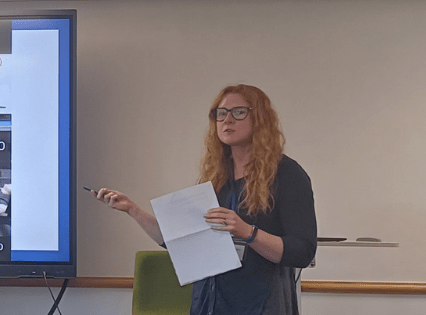
After Martine, I was up. I was very excited to give this talk, and one of the attendees, Kelli Wolfe, had told me the evening before that she’d come up from London especially to see my talk! Kelli had recently taken up resistance training and her enthusiasm was infectious. Her excitement was lovely to see and reminded me of what I call my Starting Strength Days– when I first started lifting back in 2016.
Public speaking has always been the ‘final boss’ of social anxiety for me, but I actually wasn’t sure how much was nerves and how much was excitement here – if you think about it, a lot of the body sensations are the same, and a significant part is interpretation.
Opening with a homemade meme was 100% the right call. Anyone that knows me knows I enjoy a meme: a lifting meme is good, a homemade and delightfully specific lifting meme is even better. I include it here for completeness:
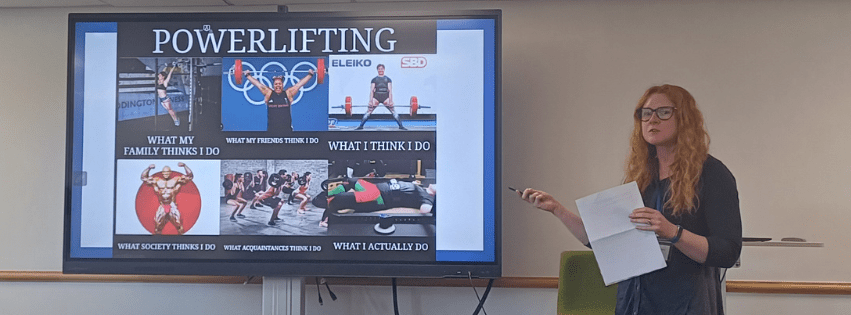
The rationale behind including this was fairly simple. While plenty of people do some version of squat/bench/deadlift in the gym, I sometimes forget how niche the sport of competitive powerlifting is because it’s such a central part of my life, and has been for almost a decade. So defining what the sport actually is – training the powerlifts to specific, and really quite stringent, competition standards with the aim of maximising 1RM performance – was really important, and partially informed by my experience of having had lots of people tell me they do Bodypump or Bootcamp when I tell them I’m a competitive powerlifter! Of course, if people like to do these then that’s great: my intention is not to be denigrating. But delineating these very different activities at the outset was key because powerlifting is so different from things like Bootcamp/Bodypump that I don’t think the same arguments can be made in relation to them: they’re not the same, and so neither are their effects.
The Q and A took us to some interesting places, including how women’s coming onto the platform is their entering a contested space, in much the same way as Martine explained how women’s being in the football stadium is. One thing which I hadn’t expected was the question, ‘What exactly is it about powerlifting that causes the flow state?’ This is a completely fair question, and I think it is hard to appreciate this if you haven’t done traditional heavy training with barbells. Hopefully my descriptions of max-effort lifts went some way to explaining this (although I initially dismissed the idea as too indulgent, maybe I should have actually included my 175kg competition deadlift video in the presentation, complete with almost-pass-out!)
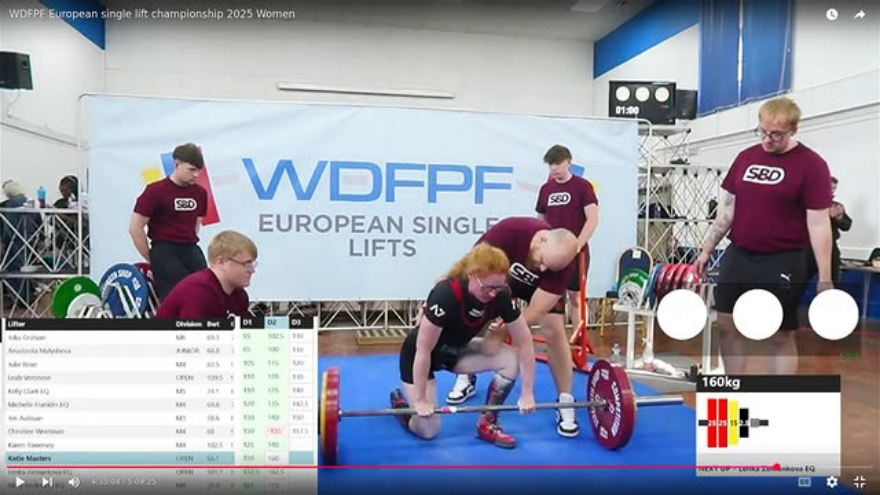
I had the thought a little while ago that a deadlift to high RPE (an 8/10 difficulty or i.e. when you’ve got 2 reps or less left in the tank for that set) fits the criteria of the philosophical concept of a ‘limit experience’. Incidentally, there’s been some work on this in other sports like CrossFit – maybe this is a paper I should write…
We also had a conversation about flow state and how it relates to anxiety, precipitated by some insightful questions from Dr Mistrelle Elmore, including whether there is justified fear, as in the case of downhill skiing, or whether fear is best described by performance anxiety. This brought up the question of to what extent you can be in a flow state while being fearful and how there’s likely a sweet spot, as we see in the Yerkes-Dodson model.
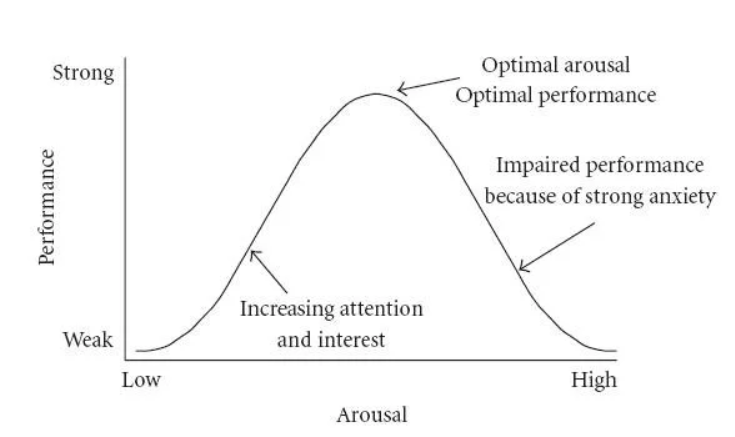
Kelli had personally experienced the ‘what you look like vs. what you can do’ shift, as had many women at her gym who, she told me, became less concerned with appearance as the weight on the bar started going up. I’m still fleshing out the nuances of what I think about this, how it relates to real and/or natural bodybuilding (as compared to mainstream – and, to be blunt, bastardised representations of it), and women’s relationships with their bodies in the context of societal surveillance and ever-evolving beauty and body ideals.
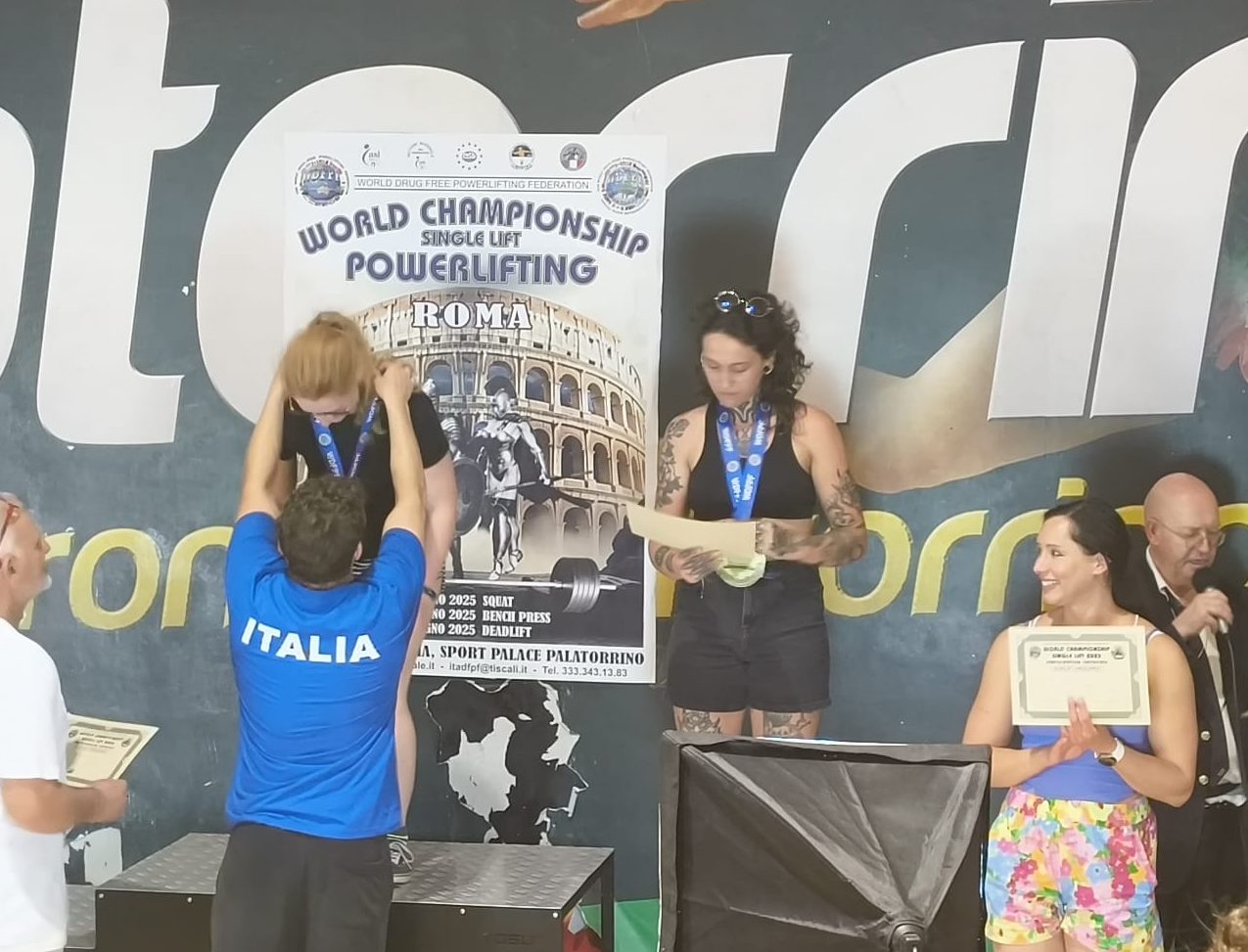
After my talk, Martine asked me if I’m World Champion (I’d put my WDFPF title in my author bio). ‘Yes, WDFPF’ (I recognise this now as my attempt to already try to diminish it, as WDFPF is a somewhat small federation.) They said I should’ve mentioned it in my intro.
‘Oh, well it’s in my author bio.’
But they’re right! We had a brief discussion about being modest or downplaying achievements, such as this one, and how it interacts with gender – and how, going forwards, I was going to try not to do it, and absolutely should shout my World (and European) title from the rooftops.
Next up we moved onto Dr Lucia Morawska’s session on SCPABooking, which stands for Social Community Publishing and Bookmaking. It’s a feminist participatory method often used to document the history of women’s football, and emerged as a response to the sport’s marginalisation in the case of women. In groups, we took match programmes, photos, and other memorabilia such as newspaper clippings, and created our own book around a theme. What I enjoyed most about the workshop was Lucia’s tenet that it doesn’t need to be perfect (I definitely suffer with perfectionism) and the fact that there are no rules (I’m the Technical Secretary for my powerlifting federation, a role which is premised on devising, updating, and enforcing The Rules). Given this, I was a little surprised that I found the workshop so enjoyable: perhaps this was because it gave me permission to operate in ways I usually wouldn’t.
To round off the day we had an In Conversation session with ocean rower Miriam Payne. Miriam talked about her lone expedition across the Atlantic, and her more recent unsupported 8000 mile row across the Pacific. Even as I try to come up with adjectives – inspiring, incredible – to describe Miriam’s feats, they just sound trite and lacking when you consider what she actually did. I’m still a mixture of humbled, awestruck, and can’t-quite-believe-it.
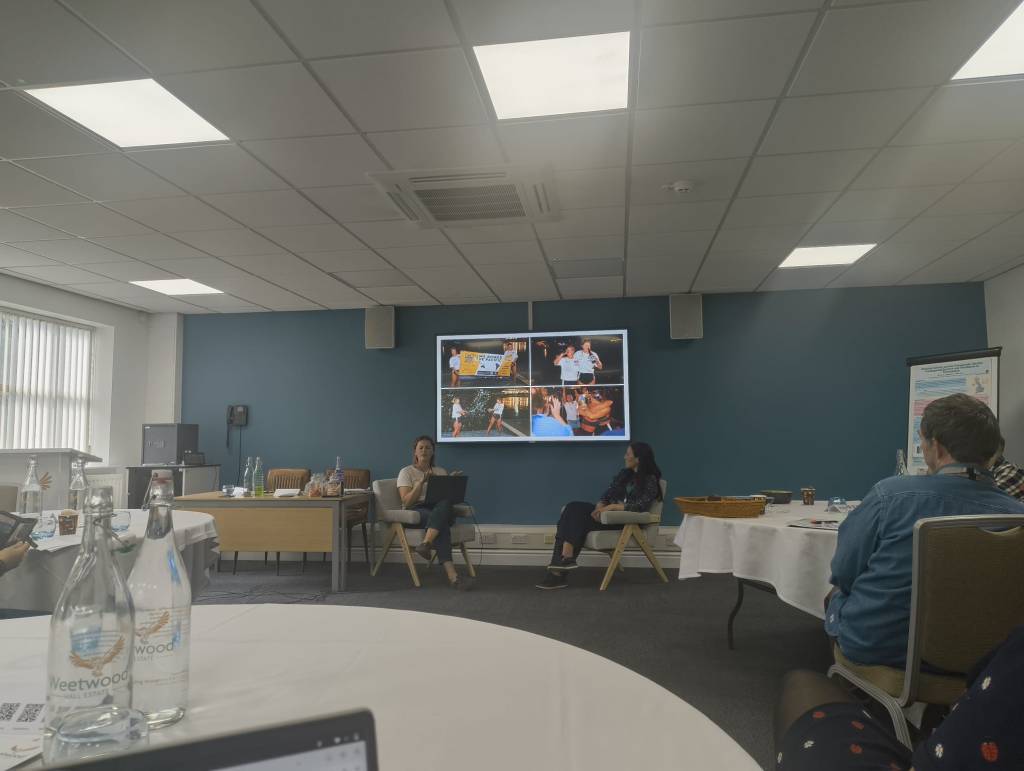
One of the conference delegates asked if Miriam had studied engineering given her problem solving abilities – she had to deal with multiple equipment failures during the Pacific crossing. Dr Samantha Bracey pointed out that we had another physicist in the room (yes, that was me – I guess this is a bit of an oddity in a predominantly social sciences space) and we had a discussion about whether that is at all associated with some of the things we decide to do. For my part – and I mentioned this in my talk – I don’t like being made to feel (or in some cases actually told – like competing in the UFC when I was ten!) that I can’t do certain things because of some defining characteristic (sex/gender). And I feel like this probably has underpinned some of the things I’ve decided to do with myself thus far, such as studying Physics at uni and becoming a bit obsessed with powerlifting. As to whether I think I’m cut out to row an ocean like Miriam? Honestly, I highly doubt it – I think I’ve done well when I manage a slow and steady 40 minutes on the Concept 2 rower while I watch a film on my tablet.
I had an exchange with Miriam afterwards, and she told me that she actually doesn’t think she’s especially gifted at rowing. One might, at first glance, think she’s just being modest, but I think she might’ve been alluding to something a bit different. There’s ‘being gifted at rowing’ in terms of being genetically gifted for endurance sports, or being powerful in the case of shorter distances. But I think Miriam is gifted in a way that’s distinct from this. That is, having the psychological makeup to be able to endure relative isolation and the harsh conditions that necessitate spending 6 months rowing across an ocean in a 10m boat.
As I prepared for my long drive back to Northamptonshire (three hours, though I did finally manage to finish Ayn Rand’s Atlas Shrugged en route, which clocks up a whopping 70 hours of listening time, so maybe I’m gifted for endurance in my own way), I bumped into Hanya in the toilet(!), at which she remarked that the toilets are a liminal space at conferences – in much the same way as the car journey with parents to and from a match serves as a liminal space for girls playing football.
Now, this is relevant and not just a funny anecdote. I’ve re-entered the academic space over the past year, and am considering whether a visiting researcher position might fit my needs. I was talking to Profs Tamara Dragadze and Martine Prange about this, and the consensus seems to be that some kind of affiliation might be beneficial – not least for the library access and institutional email! But I’d also like to turn my Springer article into a pilot study, for which I’d need ethical approval and, by extension, institutional affiliation. I have a few candidate institutions in mind, not all of which are close enough to where I live to be easily commutable. One good thing that came out of Covid was that lots of things are on Zoom now, but, I wonder, how important are these liminal spaces – being able to get coffee, bumping into a colleague by the printer, or in the library– in academia?
While I figure this out, I’m saving the date for the conference next year – 29 July, to coincide with the Tour de France’s passing through Leeds. I’ve got something in the pipeline for this: there’s some research on lifting weights as an adjunct therapy for trauma recovery. The existing studies are a bit of a hotch-potch mixture of qualitative and quantitative. What I also find interesting about this is that it disrupts the idea of sport as competition, instead, using it for healing – a bit like how Martine Prange talked about the importance of play in women’s/girls’ participation in football and how, viewing play through a Nietschzean lens, we can argue it’s a core experience of being human. In short, I think a narrative review needs doing of this existing research, and I feel like it’s got my name on it.
Post-script: Unfortunately I couldn’t go to everybody’s talk owing to there being parallel sessions (oh, to be able to be in two places at once!) and I didn’t get to do the rounds on everyone’s poster or chat to everyone I wanted to. Please feel free to drop me an email (katiemastersreseach [at] gmail.com if you’d like to get in touch or – and this is me getting with the times – you can now find me on LinkedIn (I just got it the other day, though I’ve no idea how to use the thing…) Also, huge thank you to Lucia and Sam for an unforgettable event, plus everyone else from Richmond that helped to pull the day off.
*for the nosey or fellow lifters: competition deadlift (conv), pin squats (need help with my chest fall pattern), and straight-back snatch grip RDLS (hips are my weak point in the deadlift; I’m deliberately a slightly round-backed deadlifter, though I’m trialling a straight back for some of my accessory hip hinges). Tempted to list the rep/set/RPE protocol but will leave it at that – comment if you really want to know!

Leave a comment