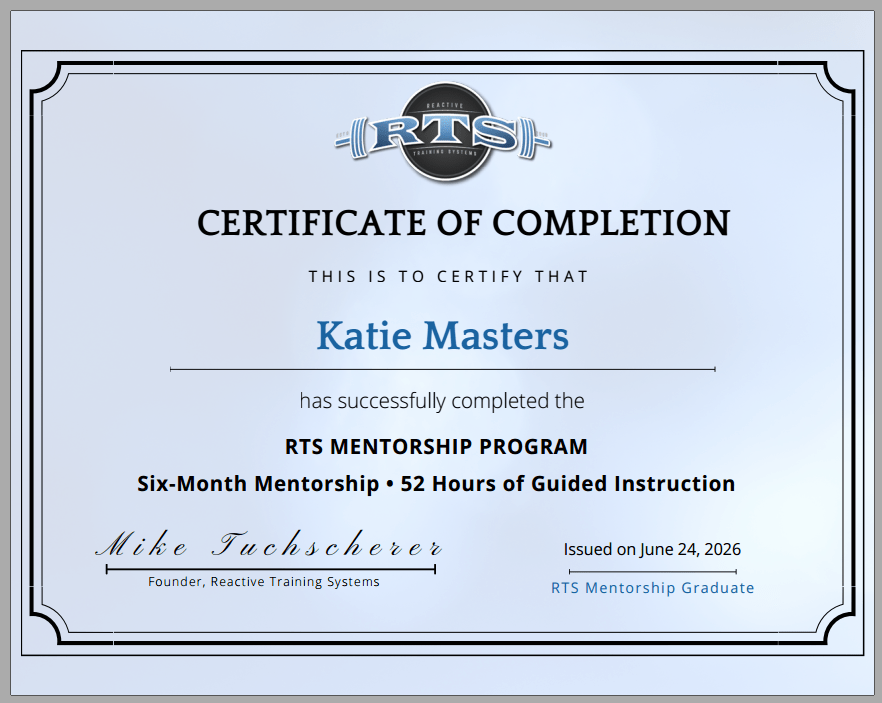
I found out about the RTS coaching mentorship by happenstance. Checking my email one day, I saw a ‘Fwd: RTS coaching mentorship’ from my friend, atop of which he’d written ‘Might be of interest? Probably a bit dear though’ (Spoiler: it was of interest; it wasn’t dear).
The Backstory – Why it Was Just what I Needed
A bit of background: I’ve been following RTS for a while. I’ve run a few of their templates – first as written, then tweaked to varying degrees – and I think, at one point, I’d listened to the entire back catalogue of their podcast. I’d even made a couple of (now, when I look back on them, a little cack-handed) attempts at running an Emerging Strategies-type protocol when I’d found stuff that worked well for me in my training.
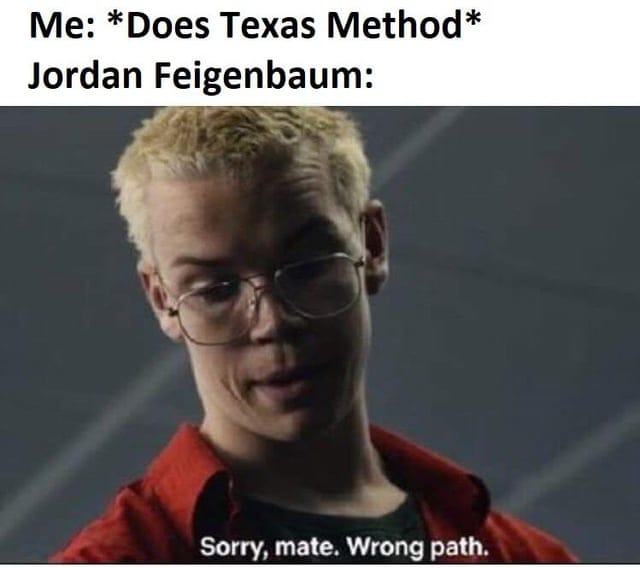
Anyone who I’ve spoken to about my own lifting history will know that I started lifting under the tutelage of Mark Rippetoe, beginning with Starting Strength and then graduating to Practical Programming. But there came a point where just using percentages and trying to add more weight over and over again stopped really working for me. Anyone who knows my lifting history will also have heard my horror stories about The Texas Method. I spoke about this a bit when I presented a case study of my squat as part of the mentorship, and I will include here some of the memes therein for your viewing pleasure.
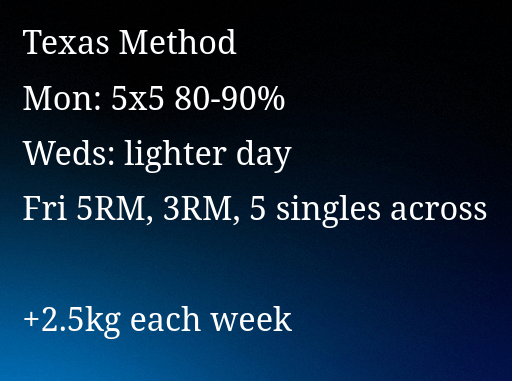
In essence, I found the Texas Method exhausting. The first run through was great – it peaked me perfectly for a meet – the second, ok, but by the time the third came around, it got to be too much. I remember starting to dread the Friday session, a 1/3/5RM where you’d have to add weight every week, and I would invariably end up covered in petechiae and feeling like I needed to go to bed for a week. And I was so, so hungry – you can forget trying to run TM if not in a bulk.

It was around this time that I became aware of Barbell Medicine (Jordan Feigenbaum and Austin Baraki, former Starting Strength Coaches and doctors who defected and set up on their own) and Austin’s own description of his experiences with the Texas Method sounded eerily familiar. ‘Perhaps I need to give this RPE thing a shot’, I thought. For the uninitiated, RTS founder Mike Tuchscherer was the first person to bring the concept of RPE, which originated in the endurance world, to powerlifting. So I adopted a more BBM way of programming for myself: autoregulating load, more volume, further from failure. And this worked wonderfully for a long time and, to be clear, BBM helped me a lot over the years, especially their approach to pain. It was also more sustainable than The Texas Method!
But over the past few years, progress hasn’t been that fast. I suppose I will always think this – I will always want to get stronger faster – but I had an inkling that something wasn’t quite hitting the mark with my programming, I just didn’t know what it was. My programming at this point was influenced by some of BBM’s strength-based stuff, and my putting a bit too much stock in Zac Robinson’s work on proximity to failure and strength gains (TL;DR, you didn’t need to go as close to failure as you think to get stronger; you probably do for hypertrophy). This resulted in protocols that were best suited for someone with 1) high/very high work capacity 2) lifts that respond well to training that targets early rate of force development. Now I’ve seen the velocity profiles for each of my big 3 lifts, this would explain why it worked very well for my bench, quite well for my deadlift, and not very well for my squat.
Inspired by the RTS manual, I started crunching numbers. I’d already been tracking e1RM for a long time, but I started tracking tonnage, number of reps and sets (and these within each intensity bracket), average intensity, average RPE per session, and so on, as well as doing this for clients. I started using velocity (fun fact: I wasn’t quite as good at gauging my RPE as I thought I was, but more on that in another post). I told a friend about my newfound love for tracking training data, and his response was, ‘You know, I think that’s what RTS do with you.’
I already knew that Mike had coached Jordan Feigenbaum at some point (going from BBM to RTS was, in effect, literally cutting out the middle man) and, looking at the way they both program, there are definite similarities. I also began to get the impression that Mike and the team at RTS knew things about lifting that other people – including lots of veteran coaches – just didn’t know. And that, if I wanted to continue progressing, I too needed to know those things.
Another funny coincidence: I also remember saying to a friend during one of our lifting chats, ‘I’d like to sit down with Mike T for a couple of hours and just ask him loads of things.’
And, maybe it was serendipity, but it was shortly afterwards that the coaching mentorship email landed in my inbox.
So that’s the backstory. What was the mentorship like?
The Mentorship – Nuts and Bolts
The mentorship had four key elements:
- the learning materials in the RTS Classroom
- the weekly mentorship calls with Mike
- the discussion group
- complimentary access to the RTS Training Lab for the duration.
It ran for 6 months, January through to June. I’m not sure if it’s a bit gauche to talk about cost, but I’m going to do it anyway. It was priced at ~£1300, with the option to pay in installments (I think this option came in at slightly more, as you’d expect). When you consider the level of expertise and number of contact hours, this is an absolute steal and I genuinely would have paid this many times over for how much I got out of it. Mine was the founding cohort, so I’m not sure if the next cohort will be at a higher price point, and I think I remember seeing in the marketing materials that subsequent cohorts might not be led by Mike T personally.
The Learning Materials
Each week there were 1–2 hours of learning materials released to us. These were videos between 20 minutes and an hour long, delivered in a lecture format: usually slides with an RTS coach visible in the corner giving a voiceover. There were a couple of podcasts thrown in there too. Topics covered pretty much everything, spanning the following:
- Emerging Strategies: the RTS signature approach to programming. This includes how to write the programming – from the ‘bottom up’ – lessons in designing microcycles; development, pivot and maintenance blocks; and how to line them up.
- Athlete monitoring: fatigue management, using Stress index and TRAC – systematised approaches for training ‘by feel’.
- GPP and durability
- Data analysis and interpretation
- Weakness analysis and biomechanics
- Exercise selection – accommodating resistance, extended ROM, targeting specific compensation patterns, e.g. chest fall in the squat.
- Velocity
- Nutrition
- ‘Soft skills’ – athlete/sports psychology
- Meet-day coaching
And probably other things I’ve forgotten. If you’re interested, some of the courses overlap with a lot of the mentorship content (namely the ES course) which you can find on the RTS site.
The Calls
The weekly hour-long calls were my favourite part. There were only ten of us on the mentorship, often fewer in the calls (I imagine work commitments or the time difference sometimes got in the way for some of the mentees), which were held at noon on Wednesdays. So, you got to know the familiar faces pretty quickly, and there was plenty of space to ask Mike things directly.
I found the other mentees to be kindred spirits. Funny story: when I presented my case study, I included the Voldemort meme and when I switched over to the slide with it on, I could actually see one of the other mentees crying because he was laughing so hard – I guess I found my audience!
The mentorship was targeted at new (2–5 years of experience) coaches and self-coached lifters. I found that we all loved lifting, loved learning, and enjoyed finding out new stuff and getting into the weeds. I’ve been accused of being akin to Louie Simmons in this video when I’m describing my own training. So it was kind of nice when some of the other mentees reeled off a protocol à la Louie: I’d found my people.
We also all seemed to be curious (not as in strange, but as in wanting to know things). So, a bit more history: I always like to know where things come from and how things are worked out. I was a bit like Marmite when I was at school: some teachers loved this inquisitiveness; others just wanted me to be quiet, accept the formula as The Truth without having seen its derivation and stop being so difficult so they could just get the rest of the class through the exam. In all fairness, having worked as a Physics/Science teacher and experienced its incumbent stressors, I appreciate the latter position more than I did when I was a student. Having said that, I still think that these situations exist is a bit of an indictment of the British education system, and in fact this inspired a prize-winning essay I wrote when I was a first year Physics undergrad (on Physics in education).
But back to the story: during the mentorship, I was never made to feel that my questions were silly (even though I’m sure some of them might have been), too many in number (likely), or too academic (also extremely likely – think ‘What would happen if…?’).
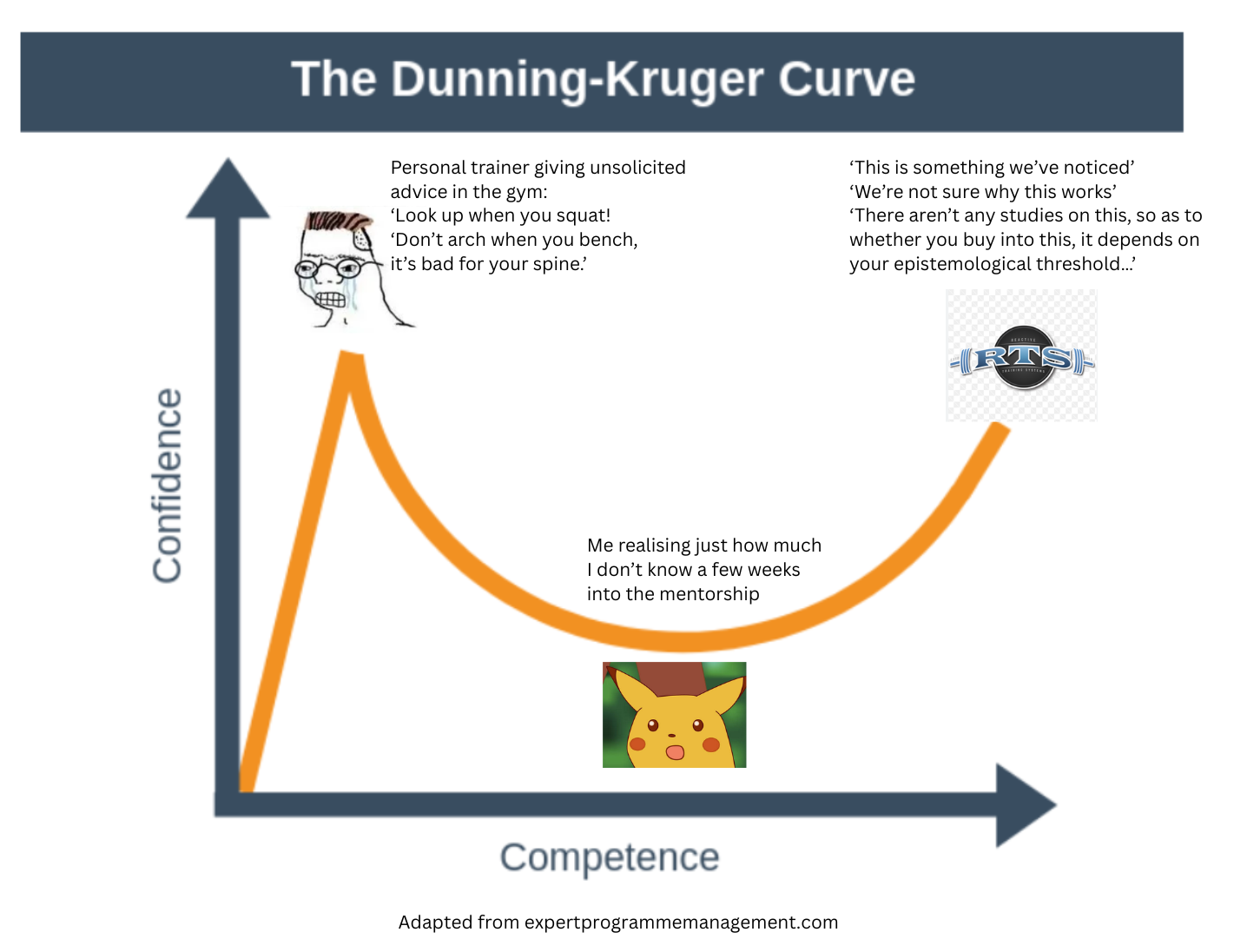
In fact, I found Mike to be incredibly open to other perspectives, and remarkably forthcoming about how certain, or not, he was about something, and why. In the fitness industry, this is a breath of fresh air, and is a fine example of the Dunning-Kruger effect in practice:
The Discussion Group
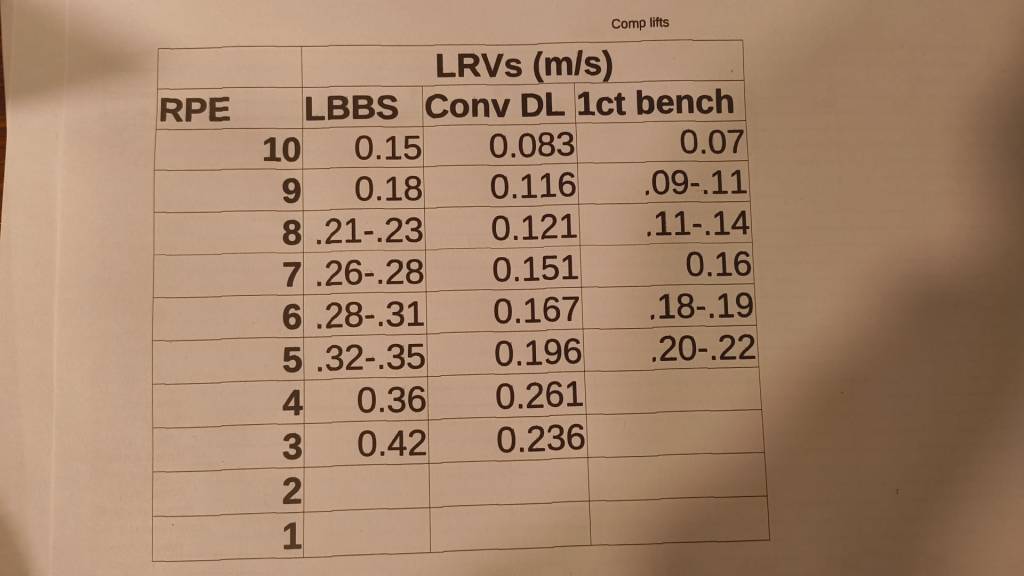
Threads from the calls – or other things we wanted to ask but didn’t get the chance to – often spilled over into the discussion group, which featured all of the mentees plus Mike and several of the other RTS coaches. Notably, Mike gave us tools to perform some velocity testing to devise our own velocity profiles for each of the powerlifts. The idea is, you can use velocity loss to target rep ranges to induce the adaptation(s) you want.
sub-10% – can build strength, likely not enough practice under fatigue to build sport form
10-25% – neuromuscular strength gains, fatigue management
25-35% – mix of strength and hypertrophy
40+% – mainly hypertrophy, explosiveness may reduce
Also, and I’m going to be intentionally vague about this as I think it might be a bit of an RTS trade secret, there’s an RPE value you get from doing this kind of velocity testing called the inflection. It’s thought that it can be beneficial to use that value as a ‘home base’. For example, my squat has an inflection point of RPE 8, and I’ve had very good results from concentrating volume around RPE 8 on my squat over the past 6 months.
The velocity profiling was useful in terms of its being instructive (ok, so we might want to target 5@8 on your squat for a mix of strength and hypertrophy) but also explanatory (ah, so that’s why my bench responds to pretty much anything but my deadlift is really fussy!).

I was also able to get Mike to look at my last rep velocities. Essentially, I did an 8RM on each lift, going to actual momentary failure. The velocity of rep 8 corresponds to RPE 10, the velocity of rep 7 corresponds to RPE 9, etc. He described them as ‘impressively grindy’ (I always knew I was a slow lifter) and that that was often a hallmark of a highly skilled lifter. This now lives in my mental trophy cabinet, right alongside Gavin Bilton describing my log press as ‘flawless’ when I went to his log and deadlift workshop a few years back!
The Training Lab
I don’t feel like I made enough use of the Training Lab during the mentorship. I’d heard about it previously on some of the RTS podcasts, but for some reason I never thought to explore it.
What is it? You get access to office hours, where you can drop in and ask an RTS coach any questions you have about your training, and there are also guest office hours with a physiotherapist, a nutritionist, and a sports psychologist.
There’s a discussion board where you can ask questions and there’s just a really nice sense of community. In addition, there are videos, e.g. one of the coaches will do a deep dive technique analysis of someone’s squat.
A very useful feature for me has been the program builder. RTS has a training log which, on its own, is free. You can track metrics such as stress index and CS balance (ratio of central to peripheral fatigue – think about the difference between 1@8 and 12@8 to get a feel for what this is), number of lifts, and tonnage. There’s also a library of many, many protocols which have been designed by RTS coaches: you can go in and tweak these according to your needs (higher/lower RPE, more/less volume, change the exercises around, etc.) and deploy the training to yourself and/or your lifters. There’s space to add custom RPE charts too.
The real gem is the block review, which is a quantitative breakdown of how well a block worked (or not, as the case may be). You can put multiple block reviews together – this is the meta block review – and this shows you common elements in blocks that saw your e1RMs go up, the idea being that you can put these elements in the block before an important competition: the ‘greatest hits’ block. (And you sincerely hope that Bulgarian split squats are not associated with an increase in your squat e1RM!)
I think the fact that I’ve kept the Training Lab on after the mentorship really says it all. Again, at the risk of sounding gauche, at just ~£26pcm it’s also ridiculously good value.
The Verdict
In case it’s not obvious, yes, I 100% would recommend this mentorship for self-coached lifters and coaches alike. As to whether I’d change anything, I really had to think about this.
There may be scope to get into the weeds a bit more on pain science and competition standards, but this likely reflects my own biases: I’m really interested in pain science and I’m an international ref and the technical secretary for my powerlifting federation! There’s also equipped lifting, but there is a separate RTS course on this which I’ve earmarked to do in the future. I was talking to Mike about this on our last call, and I think I might actually save this for when I’m old: there is going to come a point where I can’t get stronger anymore, and I just know I’ll find this difficult. So, that’s when I think I’ll become an equipped lifter.
The only other thing which springs to mind is more stuff on marketing to attract lifters (especially the kind who are going to be a good fit). This could be my bias though, since selling things (like my coaching) doesn’t come very naturally to me. Having said that, this probably points to a problem with the industry and, when I think about it, might actually be beyond the scope of the mentorship! That is, I’ve noticed that, often, the loudest voice wins; the evidence-based stuff and the stuff that actually works get buried. Think about the Dunning-Kruger curve: the confidence and certainty that only those at the top of the first peak can bring appeals; the honest uncertainty of the true expert often doesn’t. And in our culture where instant gratification is king – to quote Freddie Mercury, I think we live in a time of ‘I want it all, and I want it now,’ a lot of folks want hype, guarantees, the one weird trick and the 12-week transformation over a long article about exertion load. (Since you asked, here we are: Robert Frederick’s work on just that, which is a sort of precursor to RTS’s stress index metric. As an aside: if you can get his formula to work with velocity (loss), then let me know. I asked Mike about this and he said he’d tried but to no avail; I had a go as well but also couldn’t get it to work.)
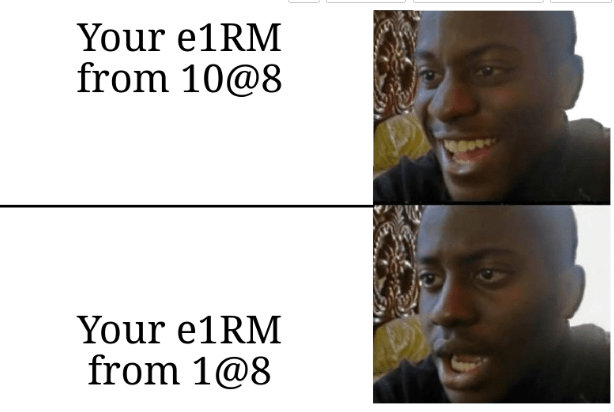
As for my own progress, I think it’s telling that it’s been notable since I started the mentorship. Only 2 months in, once I’d started implementing some of what I’d learned, I landed a comp squat PR (+7.5kg, it’d been stuck for about 2 years), a comp bench PR, and a comp total PR at my last meet. Also, my dots, based on e1RMS (which are calculated from custom RPE charts, so likely pretty accurate and not subject to the phenomenon of doing 10@8 and getting a ridiculous readout) are still on the up.
My dots are sitting at 382 as of today. Now, I know I’m not winning IPF Worlds any time soon with those dots, but when I consider that, after my first year and a half or so of serious training, I did my first comp and my dots were a whopping 212, I’m not doing too badly (and need to remind myself of this from time to time!)
But it’s not just my knowledge of how to program which has changed (though it has, hugely). I’ve learned quite a lot about myself – not just in the context of lifting, but in general.
In one of our calls, Mike said something along the lines of ‘if you keep training the same way, you’re going to keep getting the same results’. This stayed with me, because I’ve noticed that I’m uncomfortable with change – something in me likes to run the same kind of training over and over again. So, taking little leaps of faith – like dispensing with my usual taper and doing an Emerging Strategies ‘flip week’ taper for National Single Lifts – is something I need to force myself to do, despite the discomfort. It went really well in this instance; but, even if it doesn’t, I need to remind myself that it’s useful data, and, arguably, we learn more from failures than when everything goes swimmingly.
Another thing that Mike said which stuck with me was words to the effect of ‘more is better – until it isn’t’. This is probably a whole other blog post, but over the past 9 months or so, I’ve been thinking a lot about what it means to train ‘by feel’, which is something which Mike talks about in the RTS manual. There’s likely another whole blog post here too, but, on its own, I find this to be a term that’s somewhat nebulous. It’s kind of like when people talk about ‘listening to their body’. Well, what if your body lies? Or, what if it doesn’t lie as such, but what if you don’t understand it, or you don’t speak its language? Fellow lifter Casey Johnston has written about this in the context of intuitive eating:
‘My “intuition” demanded both starvation and a one-pound plate of buttered noodles. Years and years of backward, upside-down situations had made its compass go completely haywire’ (A Physical Education, p. 70).
In a lifting context, my intuition would have me max out every day and do enough volume to give myself rhabdo. Ok, well maybe not that extreme, but it would have me do too much. (Another funny story: I experimented with doing comp squat and comp deadlift in the same session a little while back. I felt absolutely wrecked later on in the day, like I had the flu. ‘This is it,’ I thought, about my impending demise, ‘This is what gets me in the end, bloody rhabdo from doing too much training.’ I found out a couple of days later that it was not, in fact, rhabdo, but that I had Covid.) And for those of us who have trouble feeling what the right amount of training is, or need some help figuring it out, having a systematised framework to guide us is a real necessity if we want to 1) progress and 2) not keep getting dinged up. The systems that Mike and RTS have designed are, to quote from the RTS manual, ‘more deliberate than going “by feel”’ (p. 40). A bit like the relationship between velocity and RIR, I find them useful for calibrating my sense of what the right amount of training is.
As to why my intuition would have me do too much if left unchecked, or needs some nurturing for me to be able to tell how much training is enough? It’s something I’m still exploring.
It’s not just in the context of my lifting that I’ve learned more about myself, but in the context of coaching. When I started coaching almost three years ago, I had the (erroneous) notion that I had to be a one-size-fits-all coach – I had to be all things to all people. I realise now that this isn’t true. Of course, all coaches need to be chameleons to some extent, but, at the risk of belaboring the metaphor, there’s a limit to the colours I can take on. To be blunt, if someone values accountability, motivation, and hype above all else; doesn’t really enjoy lifting; and has vague goals like ‘getting fitter’, I’m probably not going to be the best fit for them: I struggle to get excited about standing over someone while they use the rower, shouting ‘go on!’ By contrast, if they want help programming their deadlift to stop them ramping on their third attempt, or need someone to look at their bench to tell them if it’s comp legal, or would like a hand using a self-organised approach to modify their squat technique, or have realised they really need that custom RPE chart to help with load/attempt selection: these, I can get excited about.
This realisation underpinned the decision I made a few months ago to move from personal training and general coaching to focussing on what I love: strength and powerlifting coaching. In essence, trying to fit a round peg (a strength and powerlifting specialist) into a square hole (the demands of personal training) is not the path to a fulfilling career – at least, for me – but a fast-track to burnout.
In closing, I want to think a bit more about the role of a mentor. Merriam-Webster tells us that it’s ‘a person who gives help and advice to a less experienced and often younger person especially in a professional or academic context’. Cambridge Dictionary says it’s ‘a person who gives a younger or less experienced person help and advice over a period of time, especially at work or school’. I like these definitions, but I think they’re missing something. To me, a mentor isn’t someone who only gives you help and advice, though do this they might. Rather, they guide you so that you’ve got the wherewithal to competently navigate situations germane to the field and problem solve independently. They equip you with the tools so that you can figure out what to do for yourself. And this is pretty much how I feel after having completed the RTS Coaching Mentorship.
People who I coach, or have coached, have told me that they’ll have my voice in their head when they’re setting up for a deadlift, or hear me cueing them in some other way mid-lift when they’re training on their own. Of course, it’s not actually me in their head, it’s them. I’m sure, eventually, they’ll experience the self-cueing or setup instruction as themselves, rather than as me. So what does this have to do with the mentorship? Well, when I’m writing training, or find myself struggling to make decisions, I now sometimes have Mike’s voice in my head (I think some of the other RTS coaches are in there too). Of course, I know it’s not actually Mike, it’s me, and eventually these ‘voices’ will get internalised. But I think, at least for me, an important part of the mentorship has been discovering that now – equipped with many hours of RTS-teaching, methodology, and discussion, through which I’ve developed better critical thinking and a greater awareness of my own biases – when I have to make a lifting-related decision, a lot of the time I find I know the answer.

Leave a comment